Subscribe to our RSS feed
EconLife.com connects economics to everyday life, current events and history.

Tag Archives: bananas

16120_10.30_000008025831XSmall

The banana could be in trouble. According to a New Yorker article and video, a devastating banana fungus has struck banana plantations in Asia, Australia and the Pacific. We should note, though, that we are referring only to the Cavendish banana.

Did you know that while there are multiple banana varieties, virtually all bananas that are imported here are the Cavendish? And, we only have the Cavendish because its predecessor, the Gros Michel, was eradicated by a fungus. At the time, growers scrambled to find a substitute and selected the Cavendish. Less tasty but unscathed by the fungus, it became our banana of choice. Indeed, many of us eat more bananas than apples and oranges combined.

So, what will happen? This takes us to banana R&D (Research & Development). On plantations and in labs, growers and scientists are trying to develop resistant strains of bananas so that the Cavendish can survive. So far, Latin American plantations, including Ecuador, a major Chiquita supplier, have not been affected.

The Economic Lesson

Banana R&D represents much more than advancing banana technology. It takes us to who does research and its importance.  For example, government funds research at universities, in the Department of Defense, and the National Institutes of Health. Through tax policy and patents, it encourages research in the private sector. Meanwhile, pursuing their self-interest, businesses ranging from pharmaceutical firms to banana growers engage in basic and applied research.

Basic research has no direct purpose except to discover something new. Applied research is directed toward a specific objective. The development part of R&D refers to methods that move from discovery to production.

Posted by: adminEcon
Tags: , , ,
Comments (0) Add a Comment

16068_12.15_000013835769XSmall

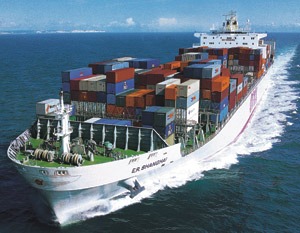
What we ship things in makes a difference.

Take the banana, for example. In 1876, at the Philadelphia Centennial Exposition, the banana was a delicacy (and very black). Millions of bunches could only be sent to U.S. shores if they were refrigerated. By 1901, as I describe in Econ 101 1/2, United Fruit was distributing 14 million bunches of bananas in the U.S. One reason, in addition to the railroad and the steamboat, was a banana vessel that could maintain a 53 degree temperature for its cargo.

Just like refrigerated banana vessels transformed world trade, so too has the cargo container. Introduced in 1956, now one ship can carry 3,000 forty foot containers with 100,000 tons of shoes, electronics and clothing. Imagine the potential efficiency. Put everything in the container, arrive at a port, and just slip it onto a truck or a railroad car for it to move to its next stop. Journalist Marc Levinson says the result is more variety for consumers, lower freight bills, less shipping time, lower inventory costs and longer supply chains.

This takes us back to yesterday’s supership post and the expansion of the Panama Canal. Larger ships mean more containers on board. The NY Times said that the newest generation of superships could hold 15,000 containers that are 20 feet long.

The Economic Lesson

Adam Smith would have been delighted to see his ideas about mass production and regional specialization extend around the world. Describing the productivity of factory pin production in The Wealth of Nations, he told us that one worker, functioning alone, could produce 1 pin per day. However, when that worker specialized through a division of labor in a factory, 4,800 pins per worker per day were made.

Adam Smith used the term “distant sale” to explain the transport of goods from a factory to a distant market. He could have been describing a container ship moving from China to the U.S.

Posted by: adminEcon
Tags: , , , , , ,
Comments (0) Add a Comment

During the 1990s, ignoring the protests of horrified Italian cheesemakers, the US placed a tariff on Pecorino cheese. The reason was bananas. Favoring their former colonies, the EU taxed bananas coming from all other Latin American countries that were grown primarily by US firms like Chiquita and Dole. The Pecorino tax was a retaliatory policy.
Finally the (banana) warring countries have agreed on a solution and all bananas will be treated equally. An article about the banana war is at:
http://uk.news.yahoo.com/18/20091215/tbs-latin-americans-eu-strike-historic-d-5268574.html

David Ricardo, a nineteenth century British economist, was the first to defend free trade through the idea of comparative advantage.
Comparative advantage: When each nation produces goods and services that have a low opportunity cost (less sacrifice) and trade them for what they do not produce, production is more efficient throughout the world.

Posted by: adminEcon
Tags: , , ,
Comments (0) Add a Comment