Subscribe to our RSS feed
EconLife.com connects economics to everyday life, current events and history.

Tag Archives: Google

profits...productivity..15800_8.3_000005470397XSmall

I suspect the whole Yahoo inspired debate about whether we work at home or at the office is taking us in the wrong direction.

Instead, I started thinking about what author Daniel Pink suggests in Drive. Discussing incentives, he says that once we are sufficiently paid at work, we need autonomy (directing our own lives), mastery (desire to get better and better at a task), and purpose (“yearning to do what we do in a service larger than ourselves”).

Pink’s ideas took me to Google’s NYC offices. Formerly a shipping complex, Google’s East Coast NYC headquarters occupies a full city block. Software engineers can design their own offices (see below), dogs can stay with their owners (below), and breakfast, lunch and dinner and snacks are free and taste good. During the workday, yoga is available as well as an occasional talk from people like Toni Morrison. Not quite your typical library, shelves open to reveal “secret” rooms and reading spaces. One hallway is lined with a Pacman arcade.

You see where this is going. The spirit and structure at Google generate the autonomy, mastery and purpose that inspire productivity. While Google employees can work at home or at work, most choose work.

But does Google have the only good answer to the home/work debate? Not necessarily. It all depends on the incentives.

A Google Office (photo credit: Marsten NY Times

A Google Office.(Photo Credit: Karsten Moran for the NY Times)

A Google Office (photo credit: Karsten Moran/NY Times)

A Google Office.(Photo Credit: Karsten Moran for the NY Times)

A Google Conference Area (photo credit: Karsten Moran/NY Times)

A Google Conference Area.(Photo Credit: Karsten Moran for the NY Times)

Sources and Resources: My description of Google’s NYC offices is based on a NY Times article, a slide show, and the Google website. To learn more about Daniel Pink’s ideas, his book is Drive: The Surprising Truth About What Motivates Us and he did a popular TED talk, but I thought his interview with Russ Roberts for Econtalk was my best source. Also, the first part of our econlife discussion of the Marissa Mayer Yahoo mandate to work at the office is here.


Posted by: adminEcon
Tags: , , , ,
Comments (0) Add a Comment

Our Transportation Infrastructure is Crumbling

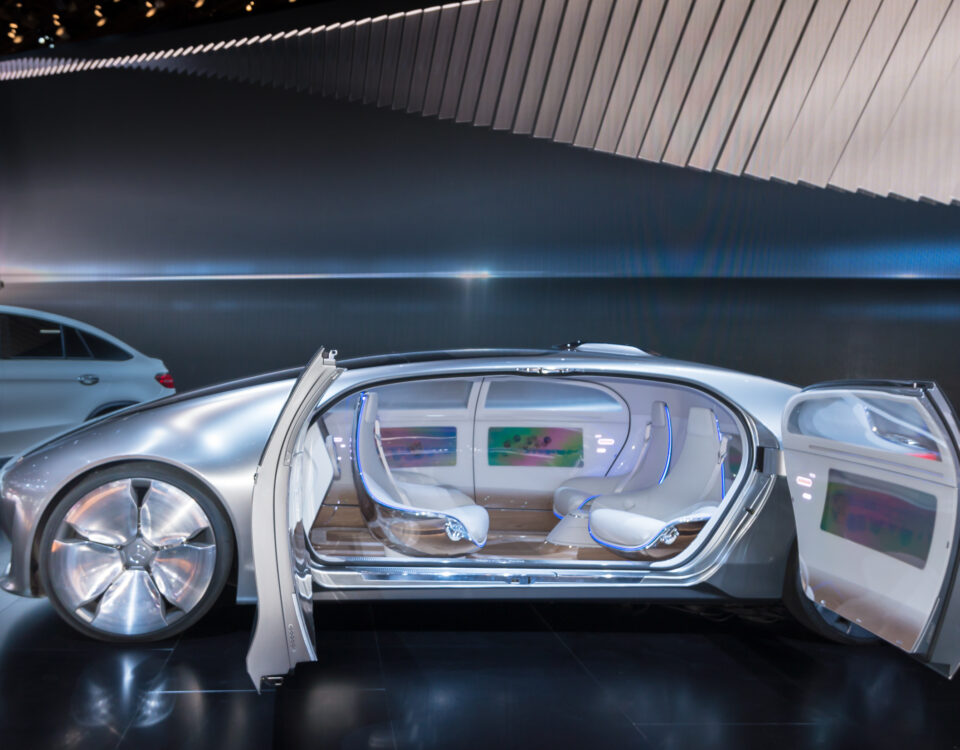
A self-driving car could be a pleasure…

The day would begin with a pick-up that you scheduled through your phone app. When your self-driving car arrived at your front door, you would get in, check today’s drive time and start to prepare for your first meeting. On the highway, the vehicle could “chain” to a sister model. At the office, it would drop you off and then return home to take your children to school. Or, it might just travel to the city’s periphery to rest for the day in a driverless car parking lot.

Much more than a gadget, “autonomous vehicles,” could make a huge difference.

  • Additional productivity in the car.
  • Extra relaxation time.
  • More safety. (After 50,000 of test miles that had no human intervention, driverless cars had no accidents.)
  • Less traffic because of “chaining” vehicles.
  • Fewer parking lots occupying valuable real estate in major cities.
  • More mobility for non-drivers.
  • Diminished carbon emissions from more efficient vehicle use.

This video of a Google car on city streets is great, especially when it stops as a garbage truck cuts in front of it and when a group of children cross the street.


New technology means winners and losers. During the beginning of the 20th century as auto ownership multiplied, buggy whips became obsolete and the US horse and mule population plunged from 26 million in 1915 to 3 million in 1960. Meanwhile, suburbia and McDonald’s became possible and gas stations became a necessity.

I know that the introduction of self-driving cars involves countless complexities. But maybe, like the first autos, they could become a transformative technology. If so, we would again have Joseph Schumpeter’s (1883-1950) creative destruction through which existing industries become obsolete because of innovation.

A final fact: Asked who pays the summons when the car goes through a red light, Google co-founder Sergey Brin said, “Self-driving cars do not run red lights.”

Sources and Resources: For details on driverless cars, I recommend this paper from KPMG and the Center for Automotive Research (CAR) and a briefer but excellent discussion from the Economist. For a reality check, though, here are articles from CNN on tests in Nevada and California whose legislatures have said that Google and other developers could test their driverless vehicles on their roads as long as a person sits behind the wheel. Also, thanks to economist Timothy Taylor’s The Conversable Economist for an introduction to self-driving vehicles.

My source for this chart on the complexities of making driverless cars a reality was the CAR paper.

From CAR/KPMG, "Self-Driving Cars: The Next Revolution"

Posted by: adminEcon
Tags: , , , , , , , , , , ,
Comments (2) Add a Comment

Stork

Headline from CNN Money: “New Yahoo CEO Mayer is Pregnant”

  • 1992: The title of a male CEO’s speech that was reprinted in the Christian Science Monitor: “A Pregnant CEO: In Whose Lifetime?” (Implying the unlikelihood.)
  • 2012: From Marissa Mayer, new Yahoo CEO: Demonstrating no concern that she was pregnant, the Yahoo Board, ”…showed their evolved thinking.”
  • From The Atlantic: “What will be really, really fantastic is when someone like Mayer can be a pregnant CEO–rather than, you know, A Pregnant CEO.
  • From writer, Rebecca Traister: ”It is great that Marissa Mayer is pregnant, but the intensity of reaction is slightly depressing. Kind of as if they’d hired a yeti.”


In 1980, there were no female CEOs in the Fortune 100 list.

As of July 17, 2012, there were 20 female CEOs in the Fortune 500 list. Here are the top 10, the firm, the Fortune rank:

  1. Meg Whitman (HP #10);
  2. Virginia Rometty (IBM #19);
  3. Patricia A Woertz (Archer Daniels Midland Company #28);
  4. Indra Nooyi (Pepsico, Inc. #41)
  5. Angela F. Braly (WellPoint, Inc. #45)
  6. Irene B. Rosenfeld (Kraft Foods Inc. #50)
  7. Ellen J. Kullman (DuPont #72)
  8. Carol M. Meyrowitz (The TJX Companies, Inc. #125)
  9. Ursula M. Burns (Xerox Corporation #127)
  10. Sheri S. McCoy (Avon Products Inc. #234)


Where does all of this take us?

To optimizing all human capital…

“In general, the best clue to a nation’s growth and development potential is the status and role of women.” (from Harvard’s David Landes, The Wealth and Poverty of Nations, p. 413).

Catalyst is a good source for female CEO info, this NBER paper discusses the changing face of all CEOs, and here is the CS Monitor speech from 1992 on the dearth of female executives.

For more on Marissa Mayer, to get to know Yahoo’s new CEO, this list of 11 facts about her was fun to read and here is an Atlantic article and one from Salon.

Posted by: adminEcon
Tags: , , , , , , , , ,
Comments (0) Add a Comment

Eye looks through a hole in the paper - spy

By Mira Korber, guest blogger.

How often do we see “Privacy Policy” at the bottom of a web page? All the time. How often do we read beyond the alliterative title? At least for me, almost never.

And thankfully so, because those privacy policies would surely be gobbling up a lot of time. According to this entertaining article from The Atlantic, a pair of researchers from Carnegie Mellon University decided to determine all the time we would spend responsibly reading all the privacy policies we encounter in a year.

Here are the numbers:

  • Median length of a privacy policy: 2,514 words
  • Time required to read: approx. 10 mins
  • Number of sites we visit with unique privacy policies: approx. 1,462
  • Individual time required to read all these policies: 25 days straight or 76 business days
  • Aggregate time required for reading: 53.8 billion hours


Next, those clever researchers decided to calculate the opportunity cost of spending all that time with your nose in a privacy policy. Their answer: $781 billion (which is larger than Florida’s GDP).  Check out their official study here.

So it’s evident to everyone by now that reading privacy policies keeps us from doing other big important things.

BUT…

Curiosity finally overcame my general laziness regarding reading Google’s new “This Stuff Matters” privacy policy. It’s controversial because it tracks your online activities, YouTube searches, and web queries more closely than ever before. Incidentally, users can’t avoid Google’s omnipresent eyeball.

Here are some creepy consequences of this new privacy policy’s power.

The Economic Lesson

Every decision comes with an opportunity cost. It’s what you sacrifice when you choose to do anything at all.

For example:

(1) Your opportunity cost of watching a horror movie may be getting a restful night’s sleep. (2) Your opportunity cost of reading a privacy policy may be searching for that suitably scary horror movie online.

(By the way, Google will probably know if you choose to search for either privacy policies or horror movies, due to the company’s new privacy policy itself.)

An Economic Question: Have you ever considered the opportunity cost of other mundane daily activities similar to reading privacy policies?

Posted by: adminEcon
Tags: , , , , , , , , ,
Comments (0) Add a Comment

16748_robot.11.15.11_000017936450XSmall

Google has a “secret” lab. Called Google X by the NY Times, it sounds like the old Bell Labs.

Before 1984, when AT&T was a monopoly, their research subsidiary Bell Labs employed a battalion of scientists. For some, the assignment was just to “think.” As a result, between 1925 and 1983, Bell Labs created the first fax machine, the original laser, the solar battery cell, light emitting diodes, the UNIX operating system on which the internet is based, digital cell phone technology, and maybe they “heard” the Big Bang.” The transistor, which led to computer microchips, touchtone phones, hi-def TVs and so many other technologies, came from Bell Labs.

Google X might embody some of the same creativity. The NY Times says that they are developing the technology for a driverless car, artificial intelligence, and contemplating a space elevator. Instead of applied research with specific goals to expand existing technology, it appears that Google X is moving beyond.

The Economic Lesson

Research and Development can be divided into 3 categories:

  • Basic research involves no articulated goals. You could throw plates in the air and watch their trajectory.
  • Applied research is more goal oriented. Parameters are constrained by a pre-determined objective.
  • Development, the final stage, involves the practical implementation of the research concept.

An Economic Question: Some say AT&T could support Bell Labs because it was a monopoly. Today, who do you believe can afford to fund seemingly “unproductive” research?

Posted by: adminEcon
Tags: , , , , , ,
Comments (0) Add a Comment