Subscribe to our RSS feed
EconLife.com connects economics to everyday life, current events and history.

Tag Archives: hyperinflation

Decisions Have An Opportunity Cost That Require Tradeoffs

Why do Brazilians drink Coca-Cola?

Our story starts during 1990. Trying to cope with an 80% monthly inflation rate, Brazilian shoppers rushed to supermarkets early in the morning before higher price stickers replaced the old ones. In just one month, a $1 carton of eggs would cost $1.80.

You can imagine what a difference it made when Brazil got its staggering price increases under control. Purchasing power soared, the middle class grew and people bought more soda.

In a paper called, “Grab Them Before They Go Generic,” 2 researchers looked at Brazil’s new spenders. Curious about multinational consumer goods, they wondered whether demand would soar for a famous, heavily advertised brand like Coke as wealth grew in an emerging economy.

The researchers concluded that when the newly affluent started shopping, they had not yet formed a soda buying habit. If they initially bought a generic brand, they stayed with it, even when they could afford more. To get people to form a “premium habit” rather than a “frugal habit,” Coke cut its prices by 20% and according to the researchers, stopped the growth of Brazilian generics.

The paper from these 2 professors, one from Hebrew University and the other from Northwestern, applies far beyond Brazil to China, India, Turkey and Indonesia–to all emerging markets where the middle class is growing. Multinationals, they believe, should recognize the importance of shaping people’s buying habits as they develop.

If you want to listen to more about Brazil’s hyperinflation and how it was controlled, NPR’s Planet Money has a wonderful podcast. And here, The Economist quantifies the growth of the middle class in emerging economies. Finally, econlife looked at how Coca-Cola might have been too late in India for the newly affluent to form a premium habit when they selected Thums Up.


Posted by: adminEcon
Tags: , , , , , , , , , , , , ,
Comments (0) Add a Comment

penny...16875_5.12_000008715889XSmall

Hearing that Zimbabweans had a limited supply of coins, I recalled one person’s response to Starbucks’ price hike to $2.01 for a tall coffee in NYC: “I can’t believe it. Now I need to walk around with pennies?”

I guess we take change for granted.

When Zimbabwe replaced its currency with the U.S. dollar, happily, they no longer had to cope with (the unimaginable) 489 billion percent inflation rate. But, using the U.S. dollar meant they had limited ability to make change. No one would trust any currency minted by Zimbabwe. But where to get enough pennies or nickels or dimes? They couldn’t.

Imagine buying $15.76 worth of groceries. You expect 24 cents change. Most of the time in Zimbabwe, there is no coin to give as change. What to do? Many people just buy more. Gum. Candy. A pen. Something that will take the purchase to an even dollar amount.

Having the right amount of money circulating in the right denominations is tougher than we might expect. I have begun to read a fascinating tale from 18th century Birmingham, England when currency problems prevented button manufacturers from paying their employees. The reason was an insufficient supply of small denomination currency from the mint. Responding, the button manufacturers produced their own coins and their employees accepted them.

The Bottom Line: For a commodity to function as money, we have to accept is as a unit of value, a medium of exchange, and a store of value.  So, perhaps we are right to take the penny for granted. Although others elsewhere may need it, maybe we no longer do.

You might enjoy this NY Times article about the situation in Zimbabwe. Then, I recommend continuing with economist George Selgin’s charming tour of early 19th century Birmingham, England and its token (coin) makers and also looking at his book, Good Money.  For a shorter description, Marginal Revolution presents a good overview of small coin shortages. And finally, econlife talks about the “annoying penny.”


Posted by: adminEcon
Tags: , , , , , , , , , , , , , , ,
Comments (0) Add a Comment

Money..16624_4.26_000006278830XSmall

In Zimbabwe, people are laundering money. Literally.

When their U.S. dollars look too gray and faded, Zimbabweans wash and dry them. In this Wall Street Journal photo, dollar bills, shirts and sheets are suspended with clothes pins along a line. Why?

First some history

During September 2008, Zimbabwe’s inflation rate was 489 billion percent. One loaf of bread sold for what 12 cars had cost a decade earlier.  People were paying their rent with groceries because no one wanted currency. The price of a morning bus ride to work? Only for that trip because soon the fare would rise.  Forget saving. What you had today was worthless tomorrow. Freeze prices? Supply evaporated. And yes, everyone was a billionaire.

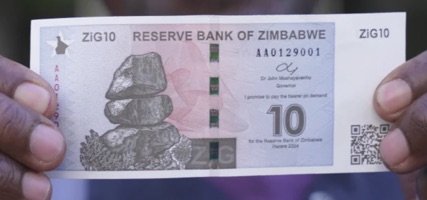
The solution was the U.S. dollar. Using the dollar as the basis of a multi-currency system in which the Zimbabwe dollar was banned, they attacked their hyperinflation. And that takes us to the laundry.

In the U.S., we have currency, checks, credit, the Fed to oversee the money supply and the U.S. mint to replace worn out bills. Not Zimbabwe. Zimbabweans have U.S. cash (or 4 other foreign currencies) and avoid their banks. As a result, they keep their cash and wash it when necessary.

The Economic Lesson

To be called money, a commodity needs 3 characteristics:

  • It should be a medium of exchange. (People willingly use the commodity for exchange.)
  • It should be a store of value. (In the future, it still will have relatively comparable purchasing power.)
  • It should be a measure of value. (When someone says one dollar, you know what that means.)

Today, in the U.S., the basic money supply includes cash, currency, travelers checks and demand deposits (checks).

When, during 2008, Zimbabwe’s inflation rate was one of the highest among the 30 countries experiencing hyperinflation since 1790, its currency could not be called money.

An Economic Question: Specifically explain why the Zimbabwean dollar cannot be called money.

Posted by: adminEcon
Tags: , , , , , ,
Comments (0) Add a Comment

16366_4.26_000006278830XSmall

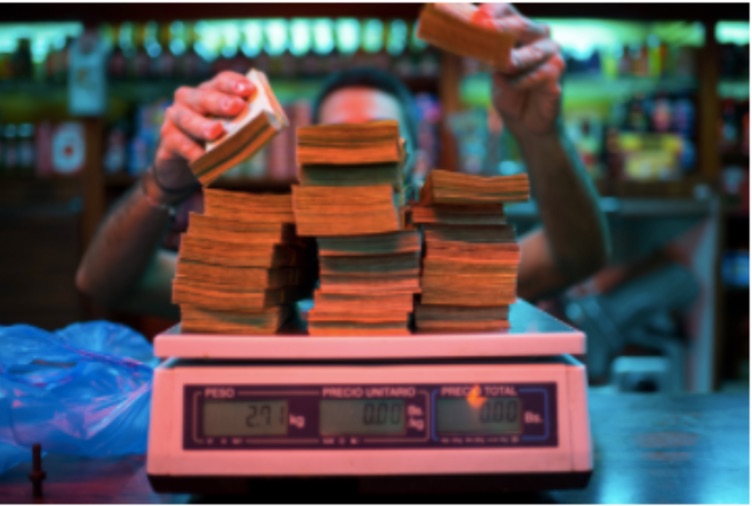
Imagine a country where supermarket employees have to raise their prices several times a day, maybe by placing one price sticker on top of the old one. Describing Brazilian inflation during the early 1990s, one woman said she raced to food markets to see if she could beat the price rise. As told in this podcast, Brazil’s inflation rate was high.

However, it was nothing like Zimbabwe’s.

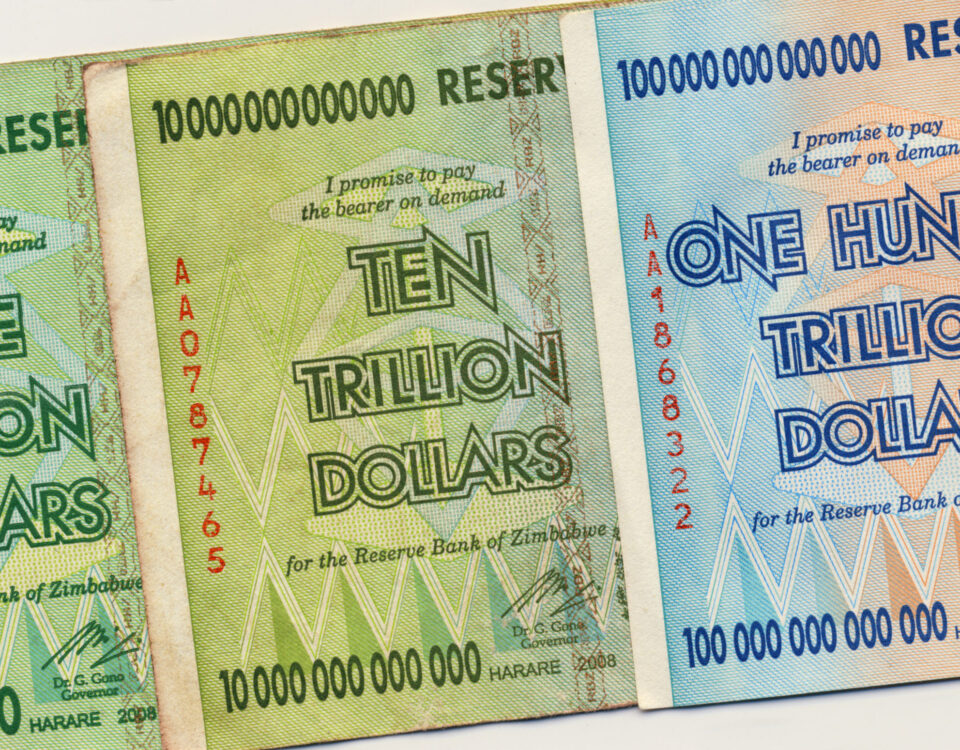
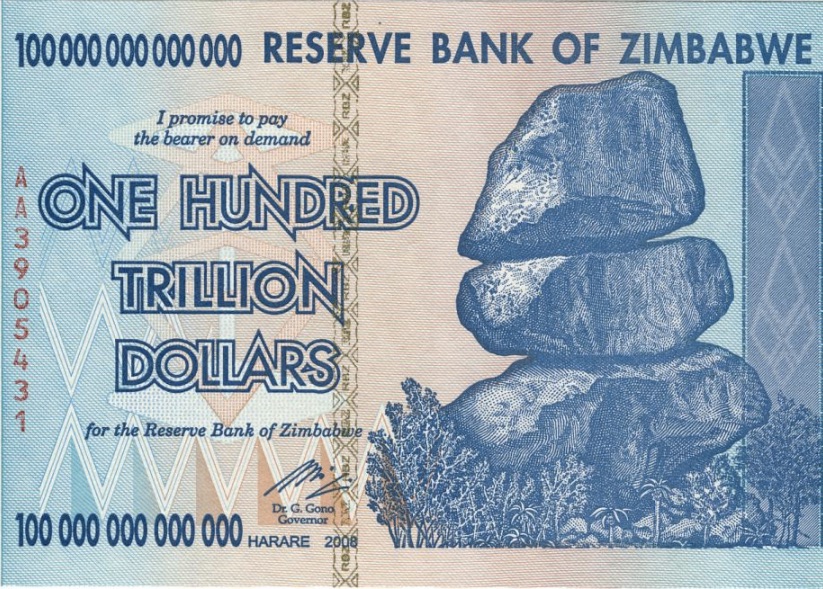
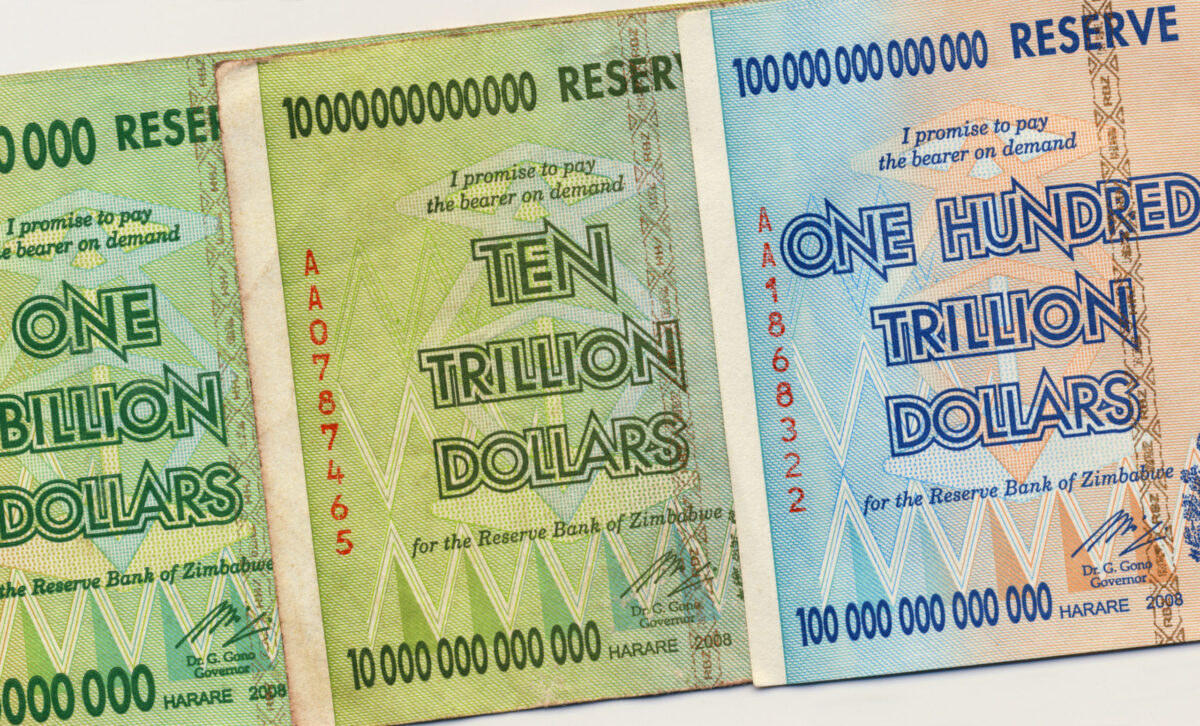
One economist has estimated that, by the time Zimbabwe replaced its own dollar with foreign currency during 2009, its annual inflation rate was close to 89.7 sextillion percent. So, you might think that the Zimbabwe dollar is worthless. Not quite. On eBay, a $100 trillion Zimbabwe dollar bill recently sold for close to $5 and currency collectors, looking for more, could push price up further.

Actually, Zimbabwe occupies second place for a world hyperinflation record. Hungary (July 1946) is #1 and Yugoslavia (January 1994) is #3.

The Economic Lesson

There are two basic ways that textbooks explain inflation:

1) Let’s assume that changes in supply relate to land, labor and capital. So, if a central bank increases the money supply, it will not affect supply. More money? Constant supply? The result is inflation.

2) Too many dollars chasing too few goods creates “demand pull” inflation; when the cost of land, labor, and/or capital rises, we have “cost push” inflation; inflation also can result when one item that is central to an economy, such as oil, becomes more expensive.

An Economic Question: Imagine living through a hyperinflation as a consumer, as a worker, or as a business owner. How would you explain the different challenges?


Posted by: adminEcon
Tags: , , , ,
Comments (0) Add a Comment

15607_4.26_000006278830XSmall

If your country’s currency is hyperinflating, then how do you buy bread? You can find a wheelbarrow or use another currency. During February, 2007, with an inflation rate exceeding 50% per month, the Zimbabwean economy experienced hyperinflation. Looking for purchasing power, people avoided Zimbabwean currency and turned to the U.S. dollar, the South African rand, Botswana’s pula, and the Zambian kwacha. One researcher estimated that in Zimbabwe, by November, 2008, prices were doubling every 24.7 hours. 

With Zimbabweans just one of many people using U.S. currency throughout the world, and computers making counterfeiting increasingly simple, the U.S. government just issued a new, forgery resistant $100 bill. Yes, Ben Franklin is still there.  But, his shoulders were added, as you tilt the bill certain areas change color, and there is a blue 3-D “security ribbon”. On a government video, you can see the new bill. In a recent column, Floyd Norris pointed out that abroad, the $100 bill is preferred.

The Economic Life

Money has three basic characteristics. 1) It is a medium of exchange. 2) It is a unit of value. 3) It provides a store of value. Hyperinflation, the plunge in value of money, immediately affects whether money is acceptable as a medium of exchange, it diminishes the value of money, and it reduces its ability to store value. 

Posted by: adminEcon
Tags: , , , ,
Comments (0) Add a Comment