Subscribe to our RSS feed
EconLife.com connects economics to everyday life, current events and history.

Tag Archives: inequality

Tax Revenue

What happens when a philosopher who believes in less government gets benefits from government?

Here is the story:

In a building that Love Story author Erich Segal owned, Harvard professor Robert Nozick (1938-2002), a libertarian philosopher, was a tenant. After paying annual rent hikes, Nozick discovered that his apartment was rent controlled and the increases were illegal. Segal, however, refused to give him a refund saying, “You’ve abdicated the right to complain.” The reason was Novick’s book, Anarchy State and Utopia, in which he explained why society had no right to “commandeer” the fruits of an individual’s talent and hard work through redistribution.

Like taxes, rent control is redistribution. Rather than moving money from the rich to the poor, rent control redistributes income from landlords to tenants through government mandated lower rent.

This story ends in court where Nozick got a favorable decision and his money.

For us, though, the story is never ending. Dr. Novick’s ideas on distributive justice take us to how we view our tax system. Is the “just” society built on a foundation of individual talent with minimal redistribution or community sharing?

For a fascinating discussion of distributive justice from the divergent views of John Rawls (redistribution can be okay) and Robert Novick (not okay), I highly recommend this Econtalk podcast and transcript. More on rent control is here and from Novick, his single page “Tale of a Slave,” here.

Posted by: adminEcon
Tags: , , , , , , , ,
Comments (0) Add a Comment

Decisions Have An Opportunity Cost That Require Tradeoffs

Through 2 stories, I learned how the design of a road can convey information about the people who live nearby.

Here are the stories…

Baltimore:

  • Greenmount Avenue in East Baltimore separates Waverly whose median income is $40,000 from Guilford, a much more affluent community. On the Waverly side, a right-angled grid of numbered streets continues and it is easy to make a turn to enter the community. Inside, you can park along the street. Meanwhile, accessing Guilford is much more challenging. Walking along more than a mile of Greenmount, you would find only 2 crosswalks. Driving, it is almost impossible to turn into the community from Greenmount because most of the streets are one-way, in the wrong direction. And once you did discover an entry point, you would soon be on narrow, winding roads that snaked unpredictably. To park, a permit is required.


Haiti:

  • With fewer mosquitos and cooler breezes, up the hill from Port-au-Prince is where affluent Haitians live. Their roads, though, are terrible. Not really roads, they are just mud and gravel and ruts and rocks that only a 4-wheel drive can navigate. Economists Daron Acemoglu (M.I.T.) and James Robinson (Harvard) explain that residents do not want good roads. They know that they could pressure government to build a road or pay for one themselves. However, their government is unable to guarantee law and order. Bad roads obscure their affluence and make a criminal’s fast get-away somewhat daunting.


You can see the connection. In Baltimore and Haiti, by shaping access, roads reflect income and status.

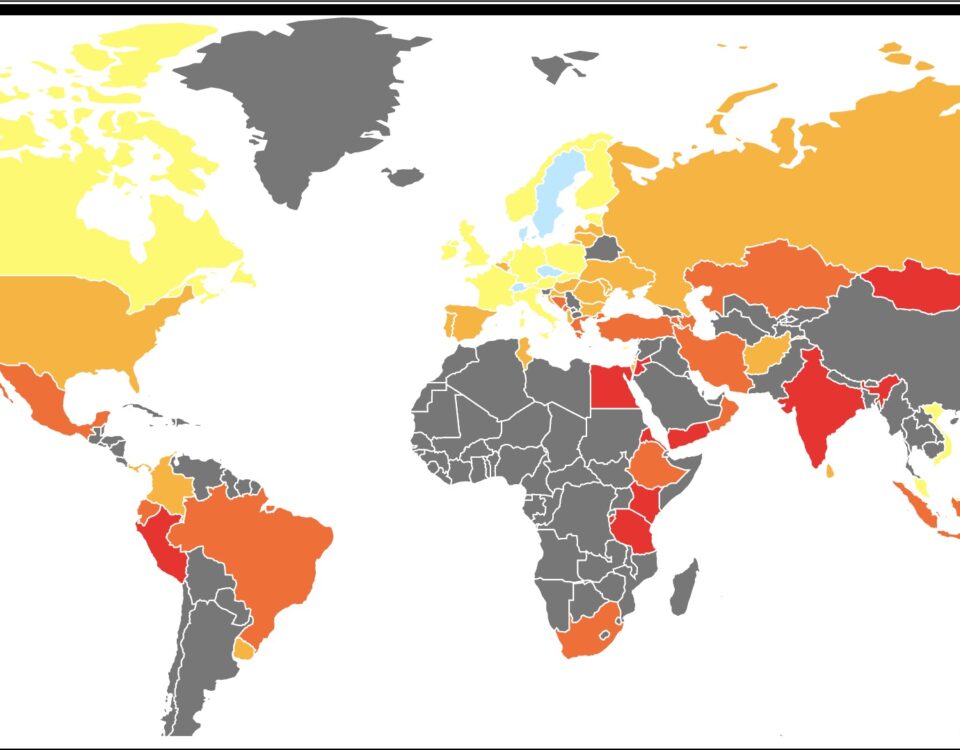
Our bottom line: Inequality has been in the news. A recent report from the Organization for Economic Cooperation and Development (OECD) tells us that the gap between the rich and poor has widened. Even in Germany, Sweden and Denmark, traditionally egalitarian, the income gap has moved from 5 to 1 during the 1980s to 6 to 1 now. For Italy, Japan, Korea and the UK, the multiple is 10 to 1 while for the US, Israel and Turkey, it is 14 to 1. The biggest spread? Chile and Mexico at 25 to 1.

My Sources: The story about Haiti is from a blog by the authors of Why Nations Fail. You can listen to the Baltimore road story in this 99 % Invisible podcast and the Guilford real estate description is here. This is the OECD report on inequality.

Posted by: adminEcon
Tags: , , ,
Comments (0) Add a Comment

Ranking Surveys Typically Are Subjective and Have Unintended Consequences.
  • Ranking income distribution, the Organization for Economic Cooperation and Development (OECD) says that Denmark is one of the most equal countries the world while Mexico is one of the least.
  • For overall well-being, Gallup selects Virginia, Wisconsin and New Jersey as the top 3 states in the U.S.
  • U.S. News ranks Harvard and Princeton #1 for 2011.

Yes? Malcolm Gladwell says not necessarily.

Explaining in the New Yorker why ranking is flawed, Gladwell emphasizes that subjective variables are tough to define.  Yes, you can choose a valid list of categories on which to base a list. Then though, it gets tricky. For the colleges list, how to quantify student engagement? Is faculty quality really about degrees and salaries?

Our bottom line: Health care, corporate responsibility, national debt, life expectancy…we see ranks everywhere. When should we be skeptical?

The Economic Lesson

When economist Robert Whaples discusses income inequality (#7) in an excellent Teaching Company series on contemporary economic issues, he first has to define income. And that, he says, is not easy.

  • Collecting data, the Census Bureau does not necessarily recognize noncash public benefits.
  • Retirement and health insurance packages are excluded.
  • Households tend to “underreport nonwage sources of income.”

In addition, changing household size is relevant. We could even debate whether we would learn more from money spent than money earned.

This returns us to the OECD’s income inequality list. Would we agree with their definition of income?

An economic question: For movies or songs, create a list and define your variables. Are they tough to quantify?

Posted by: adminEcon
Tags: , , , , ,
Comments (0) Add a Comment

Astoundingly, the country in which we are born determines 60% of our income. And then, the next 20% relates to our parents’ affluence.

Here are some answers to other interesting questions we never knew we wanted to ask. All are from The Haves and the Have-Nots.

  • Who was the richest person ever to have lived? Probably John D. Rockefeller. Looking at average income figures, the ratio of Rockefeller to the average was 116,000 to 1.
  • Compared to the world, how high is your income? Calculating Purchasing Power Parity (PPP-The Haves and the Have-Nots, p. 166), to be in the world’s top quintile, your PPP, $5,000. The top 1%? PPP is $34,000.
  • What was Anna Karenina’s upward mobility? Having had modest origins, marrying a successful civil servant elevated her to the top 1% of Russian society. Continuing to climb, her relationship with Count Vronsky took her to a man at the very top. Whereas her husband’s annual income was probably close to 9,000 rubles a year, her lover’s was 100,000.

The Economic Lesson

Through the scholarly side of The Haves and the Have-Nots, economist Branko Milanovic suggests using 3 questions to assess the impact of inequality.

  1. Identify the cause of inequality. For example, determine whether income inequality increases or decreases as the economy grows.
  2. Identify the impact of inequality. For example, does inequality create positive or negative economic incentives?
  3. Identify the ethical implications of inequality. For example, are there good and bad ways to have ascended to affluence?

An Economic Question: Being aware of your bias about income inequality in the US, how would you answer Milanovic’s 3 questions?


Posted by: adminEcon
Tags: , , , , ,
Comments (0) Add a Comment

16692_10.20_000007418499XSmall

A quiz:

  • Looking at the top 1% of earners, how many are in financial services?
  • Close to 75%, 50%, 25% or 10%?
  • The answer: 10% (or precisely 13.9%)

Next…

  • How much does the top 1% earn?
  • The 1% threshold is close to $350,000. $200,000, top 5%; 150,000, top 10%; $100,000, top 25%.
  • Here, you can identify your income group. (Stats are for adjusted gross income, 2009.)

And finally, with Occupy Wall Street expressing anger about money moguls, do most people agree? This Gallup survey concludes that more of us blame government than Wall Street for our economic difficulties.

These Occupy Wall Street interviews from NPR’s Planet Money provide an unfiltered look at individual protestor’s goals. They let us form our own opinion of the group’s objectives.

The Economic Lesson
Saying that education is crucial for income mobility, a 2010 study from the OECD concludes that U.S. intergenerational mobility is relatively low. In other words, fathers and sons, mothers and daughters remain close to the same rung on a social mobility ladder.

By contrast, this 2007 report from the U.S. Treasury indicates that there is considerable income mobility in the U.S. Describing a hotel with luxurious rooms and shabby rooms, they say that, “…those in small rooms have an opportunity to move to a better one, and that the luxurious rooms are not always occupied by the same people. The frequency with which people move between rooms is a crucial aspect of the trend in income inequality in the United States.”

An Economic Question: Explain why you would accept income inequality as a consequence of a market system or support more government redistribution of income through taxes.

Posted by: adminEcon
Tags: , ,
Comments (0) Add a Comment