Subscribe to our RSS feed
EconLife.com connects economics to everyday life, current events and history.

Tag Archives: J.P. Morgan

Self-interest represents the seeds that blossom into economic growth.

I have confessed before that I admire the entrepreneurs who have been called the robber barons.

Carnegie and steel, Rockefeller and oil, J.J. Hill and railroads, Morgan and money. These men and others from their 19th century world competed lethally. On the production side they sought to reduce costs. They battled for customers, they trampled competition and they manipulated prices. Still though, asked to choose between condemnation and admiration, I choose the latter.

Each fueled our economy. We got a capital goods sector, a transportation infrastructure. We got the foundation that let us build from consumer goods to services to our technological revolution. We got bigger homes, longer lives, refrigerators and cars and TVs and an educated populace. We had a rising economic tide that raised all boats.

And that takes me to an article in the New Yorker Magazine. Focusing on hedge fund billionaire Leon Cooperman, the article spotlights a response to President Obama’s message to the affluent about giving more to US society. In a letter to President Obama, Mr. Cooperman asks instead that the President focus on the unifying power of initiative and achievement that has inspired generations and propelled economic growth.

Mr. Cooperman’s comments took me to Adam Smith.  Rather than a benevolent government, Smith focused on how wealth is spread by self-interested business people.

“It is not from the benevolence of the butcher, the brewer, or the baker that we expect our dinner, but from their regard to their own interest.” (Wealth of Nations, Book 1 Chapter 2)

More specifically, Professor Smith explained how self-interest leads to voluntary exchange through which all benefit:

But man has almost constant occasion for the help of his brethren, and it is in vain for him to expect it from their benevolence only. He will be more likely to prevail if he can interest their self-love in his favour, and show them that it is for their own advantage to do for him what he requires of them. Whoever offers to another a bargain of any kind, proposes to do this. Give me that which I want, and you shall have this which you want, is the meaning of every such offer; and it is in this manner that we obtain from one another the far greater part of those good offices which we stand in need of.” (Wealth of Nations, Book 1 Chapter 2)

And that returns us to the most affluent slice of our society. As with Carnegie, Rockefeller, Morgan and their brethren, might we support self-interest (and accept its opportunity cost) in order to fuel the economic growth from which rich, poor, the middle class and government benefit?

Sources and Resources: I do suggest a firsthand look at The New Yorker article on Mr. Cooperman and his letter to the President. As for Adam Smith, do read some here and here so that you can decide how you feel about his ideas. Finally, Stanley Lebergott’s Pursuing Happiness provides a brief and readable picture of our 20th century material progress.

Posted by: adminEcon
Tags: , , , , , , , , , , , , , , ,
Comments (2) Add a Comment

16738_housefire.11.27.11_000016225579XSmall

Some of the euro zone’s problems actually started with the Exxon Valdez oil spill.

After the 1989 Exxon Valdez calamity, when an Alaska jury said that Exxon owed $5 billion in damages, they asked J.P. Morgan for a $4.8 billion line of credit. Concerned about so large a loan, J.P. Morgan wanted to protect itself.

So, they invented the credit default swap in 1994 at a J.P. Morgan “team-building” weekend in Boca Raton, Florida. A new kind of insurance, the credit default swap (CDS), was sort of like fire insurance that you could buy for a house you do or do not own. Instead though, the J.P. Morgan product insured different kinds loans that included money borrowed by businesses and by countries.

Let’s fast forward to today. The CDS market has grown to more than $15 trillion. In the euro zone, the CDS has become a complement to bond buying. Does a bank want to purchase an Italian bond? To minimize its risk, it needs a corresponding CDS. How did we get from Alaska to Italy? That is another story.

Here is a more technical description of a CDS.

The Economic Lesson

Selling bonds called sovereign debt, Country A is the borrower and a bank could be the lender. However, like J.P. Morgan and the Exxon line of credit, the bank then enters Country A’s CDS market to reduce its risk. If Country A defaults, the CDS seller pays the bank that bought the insurance.

When investors buy Greek, Portuguese and Italian bonds can they buy the corresponding credit default swaps and “eliminate” their risk? It all depends on what “default” means.

An Economic Question: Explain how credit default swaps might be good and bad for a nation with a history of loan defaults.

Posted by: adminEcon
Tags: , , , , , , ,
Comments (0) Add a Comment

Plunging arrow...16673_7.8_000000061495XSmall

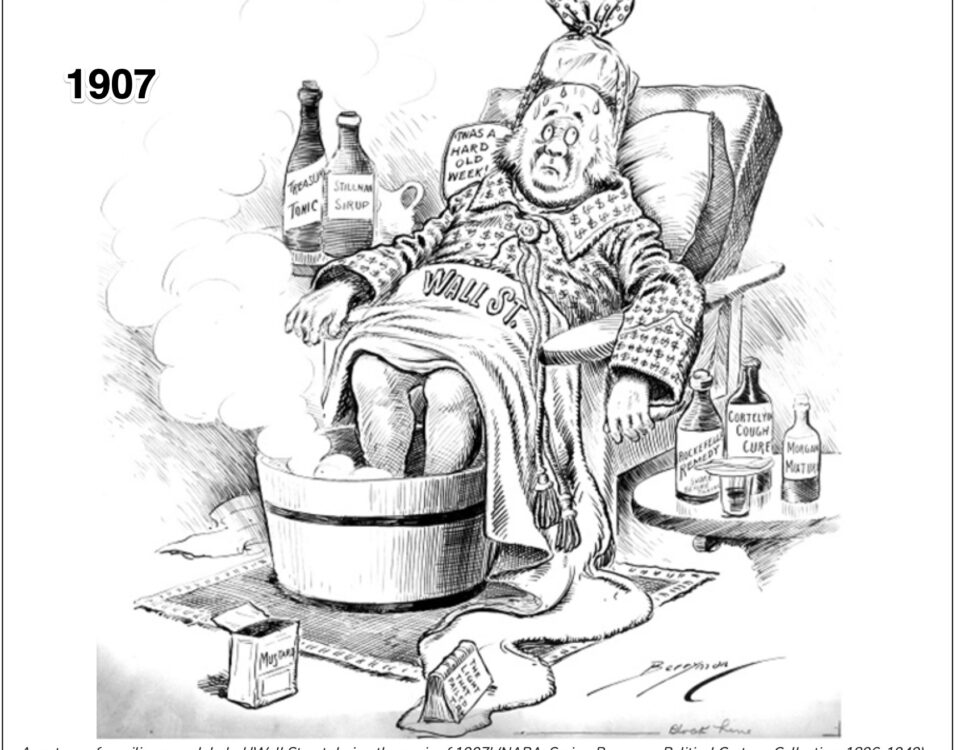
During October 1907, when the stock market crashed and the banking system panicked, we had no central monetary authority. We just had J.P. Morgan.

  • “Why don’t you tell them what to do, Mr. Morgan? (Belle da Costa Greene, J.P. Morgan’s personal librarian)
  • “I don’t know what to do myself, but sometime, someone will come in with a plan that I know will work; and then I will tell them what to do. (J. Pierpont Morgan)

Here is a description of events that preceded the 1907 panic:

“A … moralist was in the White House. War was fresh in mind. Immigration was fueling dramatic changes in society. New technologies were changing people’s everyday lives. Business consolidators and their Wall Street advisors were creating large, new combinations…The public’s attitude toward business leaders, fueled by a muckraking press, was largely negative. The government itself was becoming increasingly interventionist in society…Much of this was stimulated by…economic expansion.”

Sounds familiar.

(Quotes are from The Panic of 1907, pp. 2-3; 97)

The Economic Lesson

On October 1, 2008, the Dow Industrial Average closed at 10,831. Only 10 days later, it was at 7773.71.

1907, 1929, 1937, 1987 also had October plunges. With 16 stock market crashes during the 20th century, October has had a disproportionate share.

An Economic Question: During 1907 and 2008, the GDP declined. How might stock market crashes and banking panics relate to a contraction in the economy? 

Posted by: adminEcon
Tags: , , , ,
Comments (0) Add a Comment