Subscribe to our RSS feed
EconLife.com connects economics to everyday life, current events and history.

Tag Archives: Panama Canal

16776_12.15_000013835769XSmall

By Mira Korber, guest blogger.

As the Panama City skyline emerged from my misty Wednesday morning flight window, I must say the view was impressive. A snaking coast boasts skyscraper after skyscraper, each seeming to outdo the previous in height and marvels of modern engineering and architecture. With a 10.6% first quarter GDP growth, you feel a heating economy (and climate!) in Panama.

I, however, was not en-route to a zoody hotel in the ultra-urban section of the expanding city. I was on on my way to a monastery — where air conditioning and hot water were not part of the picture for music festival students like me. Amenities were scarce, weather in excess of 100 degrees, and humidity in the 90th percentile.

In contrast to the sleepy monastery, I felt Panama City radiating with economic activity. Dense population and feverish construction make short distances in Panama long car rides, and traffic congestion (“tranque”), a daily occurrence. Trundling through the neighborhood of Casco Viejo with instruments and musicians unceremoniously crashing around in an overstuffed bus, our driver navigated closed streets and constant construction; the entire historic district is under restoration to return cobblestone streets and stucco buildings to their full 16th/17th century Spanish architectural glory.

Ricardo Martinelli, president of Panama, has allocated those funds for rebuilding Casco Viejo and other massive construction projects, including a $1.25 billion metro construction project that keeps workers on the job 24/7.  $5.25 billion is on the books to add a third set of locks to the Panama Canal. At the moment, 35-40 ships make the passage daily, and freighters traveling both east and west share the same artery. In the 2014 centennial anniversary of the Panama Canal itself, a new set of locks will allow for traffic in both directions, bigger ships, and reuse of water.

For me, while Panama will always be about a fantastic musical experience, there was more. As I moved between unbearable heat in the monastery and then frigid air conditioning in our nearby practice room, as I observed the country’s eye-grabbing skyline and its bottomless poverty, I thought about its contrasts.

If I return for more music, I hope to see that Panama’s economic development will have as good a “conductor” as we did.

For reports of Panama’s accelerating GDP, look here and here. Festival de Alfredo Saint-Malo, in which I participated.

Posted by: adminEcon
Tags: , , , , , , , , , , ,
Comments (0) Add a Comment

16518_2.21_000006135757XSmall

By Mira Korber, guest blogger.

Just two days ago I bought a plane ticket to Panamá City International Airport in Tocumen. I will be participating in a classical music festival there, somewhat ironically studying music from centuries past as brand-new skyscrapers are erupting all around. Panamá is booming, and not just with music.

Panamá is among the fastest growing economies in all of Latin America; the 2011 GDP surged at 10.6%, up from 9.2% in 2010. A new, glittering skyline boasts the 70-story Trump tower. Central America’s first subway system project broke ground in 2011.  And a $5.25 billion construction project promises a third channel to the Panamá Canal.

As international trade has blossomed, the canal has connected the Americas and linked East with West for the past 100 years. Just since December 1999, when the US relinquished control of the canal to Panamá, it generated $6.6 billion in revenue.

Now, workers feverishly construct a larger, deeper channel to accommodate massive tankers and cargo ships coming from Asia –primarily China — heading to the United States consumer market. The project (if it doesn’t delay) is slated for completion in 2014, a century after the canal’s inaugural year. Once open for passage, the new channel will support 50% more traffic each day, and may encourage ships to travel east to Panamá from Asia, instead of traversing the Suez Canal in Egypt.

Amidst massive development projects and increasing foreign investment (+33% in 2011) lurk other concerns. Panamá’s history is blighted by crimes, perhaps most notably by ex-military dictator Manuel Noriega, whose 1983-1989 rule was marked by drug trafficking, money laundering, and murder of political opposition.

As this stigma looms, 40% of the population in Panamá lives in poverty, with an ever-growing divide between the wealthy and the poor. Even the development comes with concerns about an economic bubble – remember all those new skyscrapers? Most are dark — empty — at nighttime.

The Bottom Line? Panamá’s rapid growth is remarkable. The Economist likens its economic expansion to Singapore, although it’s not even 1/5 as wealthy (“on a per-person basis”).  However quickly Panamá may develop, the risk of corruption and interference with markets rises just as ominously. Case in point: Singapore ranks 2nd on the Index of Economic Freedom; Panamá ranks 55th.

PS. You’ll get a from-the-ground perspective on the Panamanian economic explosion when I see it in person this June.

Read about Panamá directly from El País, a Latin American newspaper (in English). NPR podcast on the subject. Delays in the construction of the new Panamá Canal channel?  NY Times offers insights on growth and Panamá’s military history.


Posted by: adminEcon
Tags: , , , , , , , , , , ,
Comments (0) Add a Comment

16066_12.14_000005316218XSmall

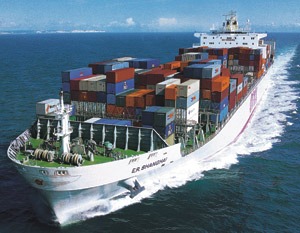
When is a supership a problem? When the water is not deep enough or the Bayonne Bridge is not high enough.

To understand the Bayonne Bridge problem (and care about the answer), we have to look back to August 1914 and then ahead to August 2014. The Panama Canal officially opened on August 14, 1914. Connecting the Pacific and Atlantic Oceans, the canal diminished transport time and cost for worldwide shippers. Now, the canal will again enhance efficiency through a widening project that should be completed during August, 2014. For a new generation of larger container ships to use the canal, it had to become wider.

But that was only the beginning. From the Panama Canal, huge ships will travel to U.S. ports. Now, according to the NY Times, many of these ports need to have their capacity extended. Georgia, for example, with national and local funding, is spending $625 million to deepen the Savannah River by 6 feet. For the Port Newark-Elizabeth Marine Terminal, the problem is not the water. It is the Bayonne Bridge. To accommodate the superships, the bridge needs to be 64 feet higher or replaced.

Will New Jersey spend the money? The Bayonne Bridge blog says, “Yes.”

The Economic Lesson

19th century economic thinker David Ricardo stated the classic defense of free trade when he expressed the principle of comparative advantage. “Trade, trade” he said because each nation then can do what it does best (where it has the comparative advantage) and the whole world benefits through greater efficiency.

By facilitating the worldwide movement of goods, the Panama Canal enables nations to specialize and to benefit from comparative advantage.


Posted by: adminEcon
Tags: , , , , , , ,
Comments (0) Add a Comment