Subscribe to our RSS feed
EconLife.com connects economics to everyday life, current events and history.

Tag Archives: Zimbabwe

penny...16875_5.12_000008715889XSmall

Hearing that Zimbabweans had a limited supply of coins, I recalled one person’s response to Starbucks’ price hike to $2.01 for a tall coffee in NYC: “I can’t believe it. Now I need to walk around with pennies?”

I guess we take change for granted.

When Zimbabwe replaced its currency with the U.S. dollar, happily, they no longer had to cope with (the unimaginable) 489 billion percent inflation rate. But, using the U.S. dollar meant they had limited ability to make change. No one would trust any currency minted by Zimbabwe. But where to get enough pennies or nickels or dimes? They couldn’t.

Imagine buying $15.76 worth of groceries. You expect 24 cents change. Most of the time in Zimbabwe, there is no coin to give as change. What to do? Many people just buy more. Gum. Candy. A pen. Something that will take the purchase to an even dollar amount.

Having the right amount of money circulating in the right denominations is tougher than we might expect. I have begun to read a fascinating tale from 18th century Birmingham, England when currency problems prevented button manufacturers from paying their employees. The reason was an insufficient supply of small denomination currency from the mint. Responding, the button manufacturers produced their own coins and their employees accepted them.

The Bottom Line: For a commodity to function as money, we have to accept is as a unit of value, a medium of exchange, and a store of value.  So, perhaps we are right to take the penny for granted. Although others elsewhere may need it, maybe we no longer do.

You might enjoy this NY Times article about the situation in Zimbabwe. Then, I recommend continuing with economist George Selgin’s charming tour of early 19th century Birmingham, England and its token (coin) makers and also looking at his book, Good Money.  For a shorter description, Marginal Revolution presents a good overview of small coin shortages. And finally, econlife talks about the “annoying penny.”


Posted by: adminEcon
Tags: , , , , , , , , , , , , , , ,
Comments (0) Add a Comment

Money..16624_4.26_000006278830XSmall

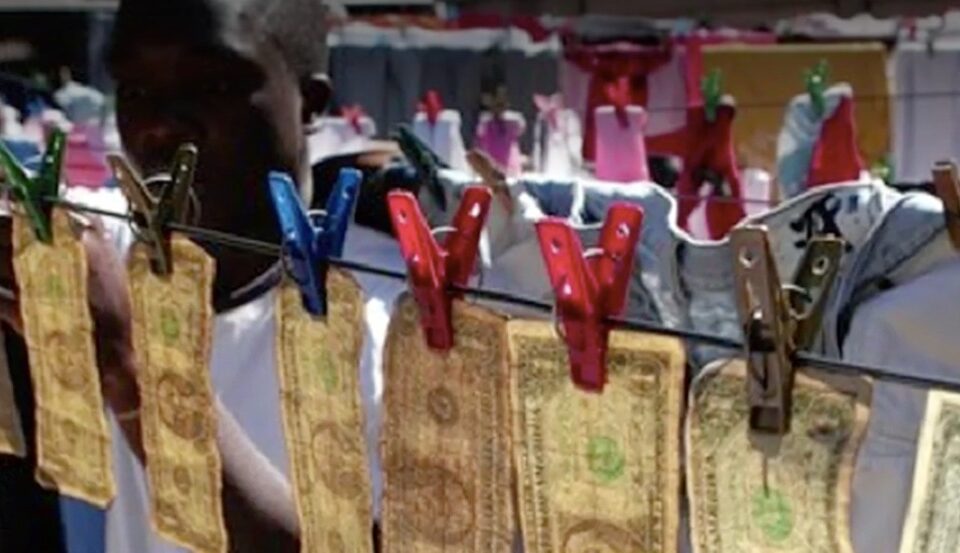
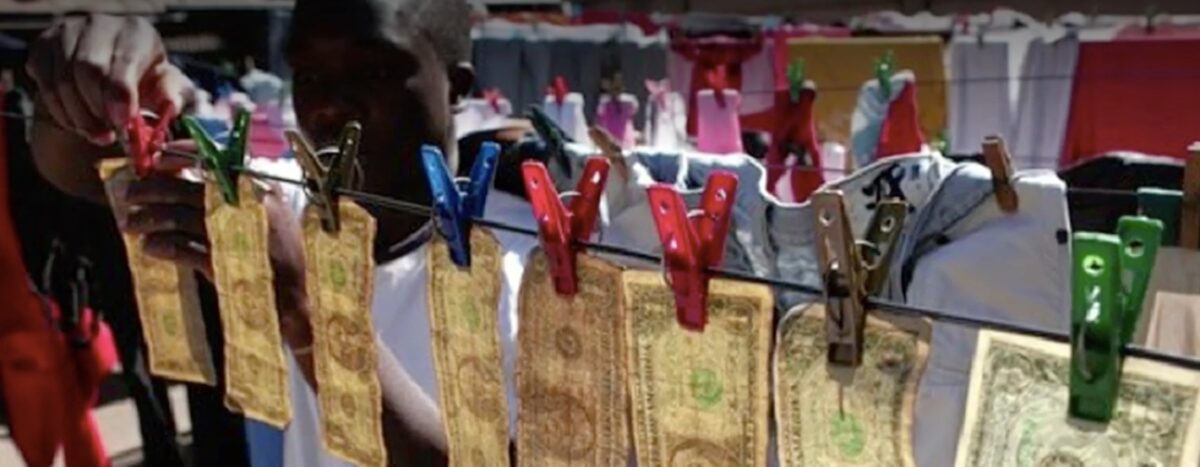
In Zimbabwe, people are laundering money. Literally.

When their U.S. dollars look too gray and faded, Zimbabweans wash and dry them. In this Wall Street Journal photo, dollar bills, shirts and sheets are suspended with clothes pins along a line. Why?

First some history

During September 2008, Zimbabwe’s inflation rate was 489 billion percent. One loaf of bread sold for what 12 cars had cost a decade earlier.  People were paying their rent with groceries because no one wanted currency. The price of a morning bus ride to work? Only for that trip because soon the fare would rise.  Forget saving. What you had today was worthless tomorrow. Freeze prices? Supply evaporated. And yes, everyone was a billionaire.

The solution was the U.S. dollar. Using the dollar as the basis of a multi-currency system in which the Zimbabwe dollar was banned, they attacked their hyperinflation. And that takes us to the laundry.

In the U.S., we have currency, checks, credit, the Fed to oversee the money supply and the U.S. mint to replace worn out bills. Not Zimbabwe. Zimbabweans have U.S. cash (or 4 other foreign currencies) and avoid their banks. As a result, they keep their cash and wash it when necessary.

The Economic Lesson

To be called money, a commodity needs 3 characteristics:

  • It should be a medium of exchange. (People willingly use the commodity for exchange.)
  • It should be a store of value. (In the future, it still will have relatively comparable purchasing power.)
  • It should be a measure of value. (When someone says one dollar, you know what that means.)

Today, in the U.S., the basic money supply includes cash, currency, travelers checks and demand deposits (checks).

When, during 2008, Zimbabwe’s inflation rate was one of the highest among the 30 countries experiencing hyperinflation since 1790, its currency could not be called money.

An Economic Question: Specifically explain why the Zimbabwean dollar cannot be called money.

Posted by: adminEcon
Tags: , , , , , ,
Comments (0) Add a Comment

16366_4.26_000006278830XSmall

Imagine a country where supermarket employees have to raise their prices several times a day, maybe by placing one price sticker on top of the old one. Describing Brazilian inflation during the early 1990s, one woman said she raced to food markets to see if she could beat the price rise. As told in this podcast, Brazil’s inflation rate was high.

However, it was nothing like Zimbabwe’s.

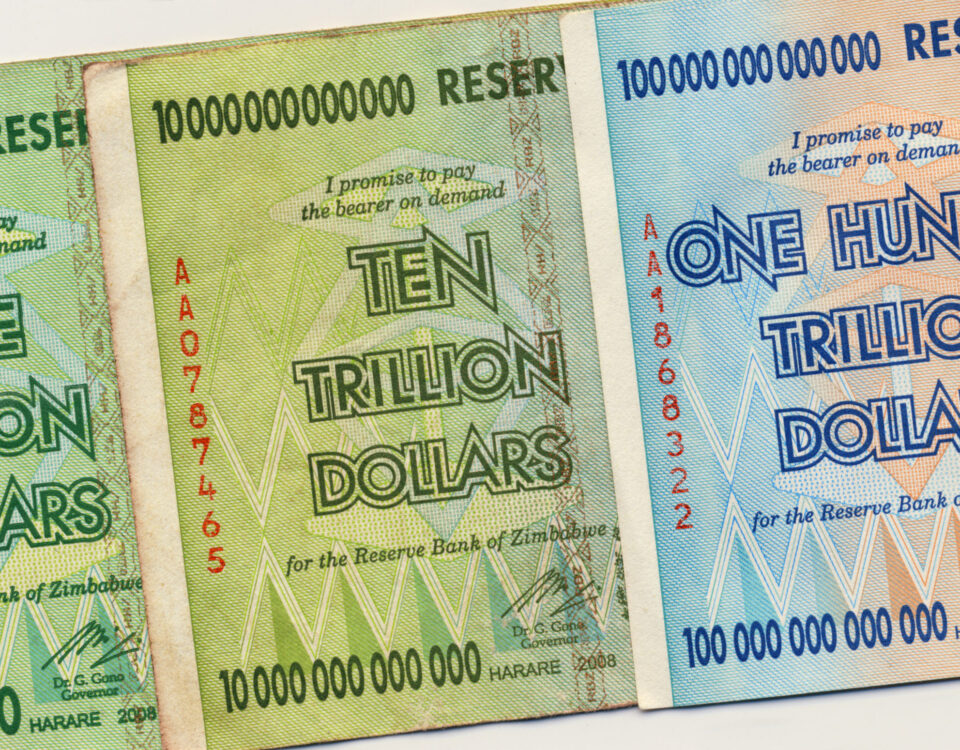
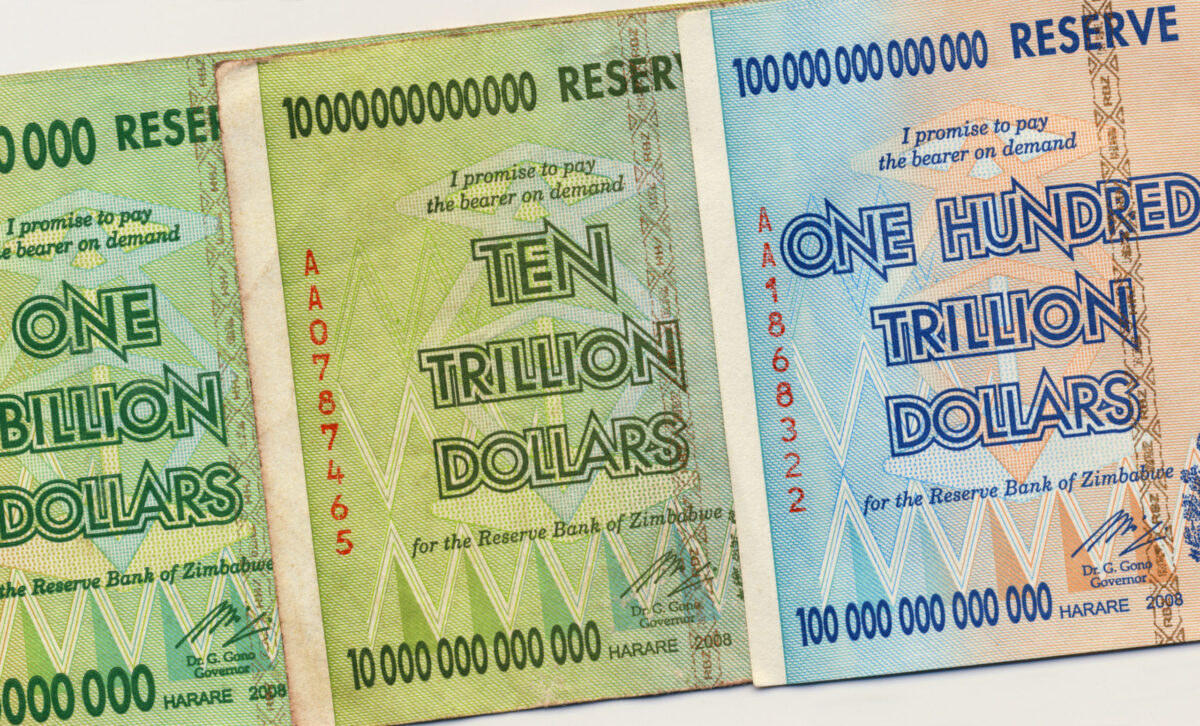
One economist has estimated that, by the time Zimbabwe replaced its own dollar with foreign currency during 2009, its annual inflation rate was close to 89.7 sextillion percent. So, you might think that the Zimbabwe dollar is worthless. Not quite. On eBay, a $100 trillion Zimbabwe dollar bill recently sold for close to $5 and currency collectors, looking for more, could push price up further.

Actually, Zimbabwe occupies second place for a world hyperinflation record. Hungary (July 1946) is #1 and Yugoslavia (January 1994) is #3.

The Economic Lesson

There are two basic ways that textbooks explain inflation:

1) Let’s assume that changes in supply relate to land, labor and capital. So, if a central bank increases the money supply, it will not affect supply. More money? Constant supply? The result is inflation.

2) Too many dollars chasing too few goods creates “demand pull” inflation; when the cost of land, labor, and/or capital rises, we have “cost push” inflation; inflation also can result when one item that is central to an economy, such as oil, becomes more expensive.

An Economic Question: Imagine living through a hyperinflation as a consumer, as a worker, or as a business owner. How would you explain the different challenges?


Posted by: adminEcon
Tags: , , , ,
Comments (0) Add a Comment

16082_12.22_000009138140XSmall

Do you think that the BPP is more accurate than the CPI?

Based at MIT, The Billion Prices Project (BPP) monitors close to 5 million items sold by approximately 300 retailers in 70 countries. Using the BPP, we can choose a country and then see, on a daily basis, what is happening to prices. In Argentina, for example, prices have been rising at an annual rate of 20% while in the U.S. the annual rate is closer to 2%.

The Consumer Price Index, the more traditional yardstick of prices in the U.S., is a monthly statistic. Described in this Planet Money podcast, the data for the CPI is gathered by people who record prices for the same specific products, month after month. One person could be following a certain type of dress while another looks at grapefruits. With certain items given more (mathematical) weight then others, the goods and services in the CPI form an imaginary market basket whose price fluctuates. 

Which type of yardstick should our government use for making policy decisions?

The Economic Lesson

When prices go up or down too much or too fast, they create problems. Businesses can’t plan for the future so they produce less. Consumers cannot plan so they buy less and save less. Workers experience vast swings in the purchasing power of the money they earn. When prices change too much, the information they represent becomes increasingly meaningless until, as in Zimbabwe, supermarkets refuse to stock their shelves.

As discussed by Dr. Robert Whapples in a Teaching Company Lecture, economies function better when prices are relatively stable. To achieve price stability, monetary and fiscal policy makers need information from the CPI and other price indexes.

So, when the price of gas rises from $1.40 to $3.00, drivers and policy makers respond.


Posted by: adminEcon
Tags: , , ,
Comments (0) Add a Comment

15607_4.26_000006278830XSmall

If your country’s currency is hyperinflating, then how do you buy bread? You can find a wheelbarrow or use another currency. During February, 2007, with an inflation rate exceeding 50% per month, the Zimbabwean economy experienced hyperinflation. Looking for purchasing power, people avoided Zimbabwean currency and turned to the U.S. dollar, the South African rand, Botswana’s pula, and the Zambian kwacha. One researcher estimated that in Zimbabwe, by November, 2008, prices were doubling every 24.7 hours. 

With Zimbabweans just one of many people using U.S. currency throughout the world, and computers making counterfeiting increasingly simple, the U.S. government just issued a new, forgery resistant $100 bill. Yes, Ben Franklin is still there.  But, his shoulders were added, as you tilt the bill certain areas change color, and there is a blue 3-D “security ribbon”. On a government video, you can see the new bill. In a recent column, Floyd Norris pointed out that abroad, the $100 bill is preferred.

The Economic Life

Money has three basic characteristics. 1) It is a medium of exchange. 2) It is a unit of value. 3) It provides a store of value. Hyperinflation, the plunge in value of money, immediately affects whether money is acceptable as a medium of exchange, it diminishes the value of money, and it reduces its ability to store value. 

Posted by: adminEcon
Tags: , , , ,
Comments (0) Add a Comment